
Security
Gasoline is designed for teams that can’t afford data leaks. Every design decision prioritizes keeping your browser data on your hardware — no exceptions, no opt-outs, no “trust us” promises. Zero dependencies. Localhost only. Open source (AGPL-3.0).
Automatic Credential Stripping
Section titled “Automatic Credential Stripping”Network requests are sanitized before they’re ever written to disk. The extension strips any header matching:
authorization, cookie, set-cookie, x-api-key, x-auth-token,x-secret, x-password, *token*, *secret*, *key*, *password*This is a regex-based pattern match (case-insensitive). If a header name contains token, secret, key, or password anywhere in it, it’s removed. No configuration needed — it’s always on.
What gets redacted
Section titled “What gets redacted”| Data Type | Action | When |
|---|---|---|
Authorization header | Stripped | Always |
Cookie / Set-Cookie | Stripped | Always |
Custom auth headers (X-API-Key, etc.) | Stripped | Always |
Any header matching *token*, *secret*, *key*, *password* | Stripped | Always |
| Password input values | Replaced with [redacted] | Always |
Credit card fields (cc-number, cc-exp, cc-csc) | Replaced with [redacted] | Always |
| Sensitive autocomplete fields | Replaced with [redacted] | Always |
Double-layer redaction
Section titled “Double-layer redaction”Sensitive data is caught at two points:
- Extension — strips headers and input values before sending to the server
- Server — re-checks and redacts password values on ingest as a safety net
Even if a bug in the extension missed something, the server catches it.
Localhost-Only Binding
Section titled “Localhost-Only Binding”The server binds exclusively to 127.0.0.1:
addr := fmt.Sprintf("127.0.0.1:%d", *port)http.ListenAndServe(addr, nil)This is a TCP-level restriction — the operating system itself rejects connections from any non-local address. No firewall configuration needed. No “disable remote access” checkbox to forget. It’s architecturally impossible for a remote machine to reach the server.
- Not accessible from your LAN
- Not accessible from the internet
- Not accessible from Docker containers (unless explicitly bridged)
- Not accessible from VMs on the same host
Zero Network Calls
Section titled “Zero Network Calls”The Go binary never initiates outbound network connections. It doesn’t:
- Phone home for updates
- Send telemetry or analytics
- Check license servers
- Resolve DNS
- Make any HTTP requests
You can verify this with tcpdump, lsof -i, or any network monitor. The binary opens one listening socket on localhost and that’s it.
Zero Dependencies — Zero Supply Chain Risk
Section titled “Zero Dependencies — Zero Supply Chain Risk”The server is a single statically-compiled Go binary with no external dependencies:
- No
node_modules/with thousands of transitive packages - No Python virtualenvs
- No dynamic linking (on Linux: fully static)
- No runtime downloads
The binary you audit is the binary you run. There’s no dependency tree to worry about, no lock file drift, no protestware risk. One file, checksum it, done.
The extension is vanilla JavaScript — no webpack, no transpilers, no npm packages. The source in the Chrome Web Store is the same source in the repo. Readable in DevTools.
Rate Limiting & Circuit Breaker
Section titled “Rate Limiting & Circuit Breaker”Server-side rate limiting
Section titled “Server-side rate limiting”The server enforces a 1,000 events/second cap. Beyond that, it returns HTTP 429:
| Threshold | Action |
|---|---|
| < 1,000 events/sec | Normal processing |
| > 1,000 events/sec | HTTP 429, events dropped |
| Memory hard limit (50MB) | HTTP 503, events dropped |
This prevents a runaway page from flooding your disk with gigabytes of logs.
Extension-side circuit breaker
Section titled “Extension-side circuit breaker”If the server goes down, the extension doesn’t spin trying to reconnect:
| State | Behavior |
|---|---|
| Closed (normal) | Send events normally |
| Open (5 consecutive failures) | Stop sending, wait 30s |
| Half-open (after timeout) | Send one probe request |
| Backoff | Exponential: 1s → 2s → 4s → … → 30s max |
No CPU burn. No memory leak from queued retries. The extension backs off gracefully.
Memory-Safe Buffers
Section titled “Memory-Safe Buffers”Every buffer in the system has a hard cap:
Extension limits
Section titled “Extension limits”| Buffer | Max Size | Overflow Behavior |
|---|---|---|
| WebSocket messages | 4KB per message | Truncated |
| Request bodies | 8KB | Truncated |
| Response bodies | 16KB | Truncated |
| User action buffer | 20 items | FIFO eviction |
| Context annotations | 50 keys, 4KB/value | Rejected with warning |
| Overall extension memory | 20MB soft / 50MB hard | Buffers reduced or features disabled |
Server limits
Section titled “Server limits”| Buffer | Max Size | Overflow Behavior |
|---|---|---|
| WebSocket event ring | 500 events | Oldest dropped |
| Network bodies ring | 100 entries | Oldest dropped |
| Enhanced actions | 50 entries | Oldest dropped |
| Active WS connections | 20 tracked | Oldest dropped |
| WebSocket buffer total | 4MB | HTTP 503 |
| Network bodies total | 8MB | HTTP 503 |
| Server memory total | 50MB hard limit | HTTP 503 |
At no point can a misbehaving page consume unbounded memory in either the extension or the server.
Minimal Extension Permissions
Section titled “Minimal Extension Permissions”The Chrome extension requests only:
| Permission | Why |
|---|---|
activeTab | Inject capture scripts into the current tab |
storage | Persist extension settings locally |
alarms | Schedule periodic health checks |
tabs | Query tab URL for log context |
Host permissions are restricted to:
http://localhost/*http://127.0.0.1/*Not requested:
- No
webRequest/webRequestBlocking - No
debugger - No
history,bookmarks,downloads - No broad host permissions (
<all_urls>) - No
identityor OAuth scopes
Log File Security
Section titled “Log File Security”- Default location:
~/gasoline-logs.jsonl(user’s home directory) - File permissions:
0644(user read/write, others read-only) - Append-only: Server only appends, never seeks or rewrites in-place
- Automatic rotation: Oldest entries dropped when
--max-entriesexceeded (default 1000) - No external access: File is read by the AI tool via stdio (MCP), not via HTTP
The AI tool reads the file directly from disk — no network layer, no API endpoint, no token exchange.
Input Validation
Section titled “Input Validation”Every endpoint validates input before processing:
| Endpoint | Validation |
|---|---|
POST /logs | JSON structure, required entries array, entry format |
POST /v4/* | JSON body parsing, size limits, type checking |
| MCP (stdio) | JSON-RPC 2.0 structure, method whitelist, parameter validation |
| All endpoints | Rate limiting, memory cap checks before processing |
Malformed input returns appropriate HTTP errors (400, 429, 503) — never crashes, never executes arbitrary content.
Open Source Audit
Section titled “Open Source Audit”The entire codebase is open under AGPL-3.0:
- Go server: ~1,000 lines, zero dependencies, fully auditable in an afternoon
- Extension: Vanilla JS, no build step, readable in Chrome DevTools
- No obfuscation: What you see in the repo is what runs on your machine
- Reproducible builds:
make buildproduces identical binaries from source
# Verify the binary yourselfgit clone https://github.com/brennhill/gasolinecd gasoline && make buildshasum -a 256 bin/gasoline-*Data Flow Diagram
Section titled “Data Flow Diagram”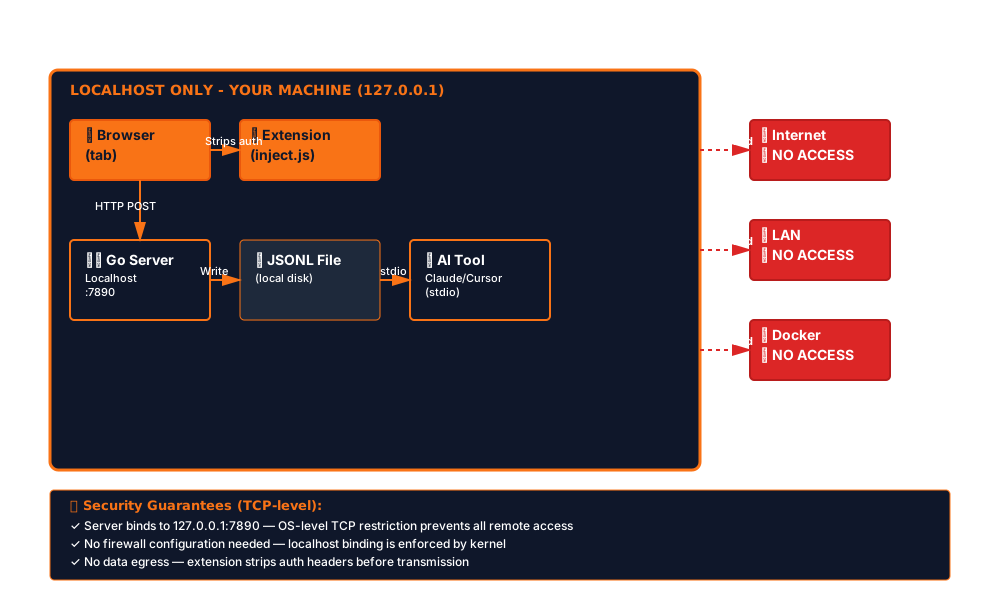
Enterprise Deployment
Section titled “Enterprise Deployment”For teams evaluating Gasoline:
- Data governance: No data egress — all debugging data stays on the developer’s machine, never transmitted externally
- Audit trail: Open source, reproducible builds, no telemetry to verify absence of
- IT approval: Single binary, no runtime deps, no outbound network, minimal permissions
- Onboarding:
npx gasoline-mcp— no accounts, no API keys, no license management - Offboarding: Delete the binary and log file. No cloud state to clean up